

BuildingGPT
Querying building semantics using LLMs and Vector-Graph RAG
BuildingGPT is a semantic-AI intelligence layer that sits above existing BMS/SCADA infrastructure and allows facility teams to ask building questions in everyday language, retrieve traceable answers, review operational data, and move from manual data hunting toward explainable diagnosis and decision support.
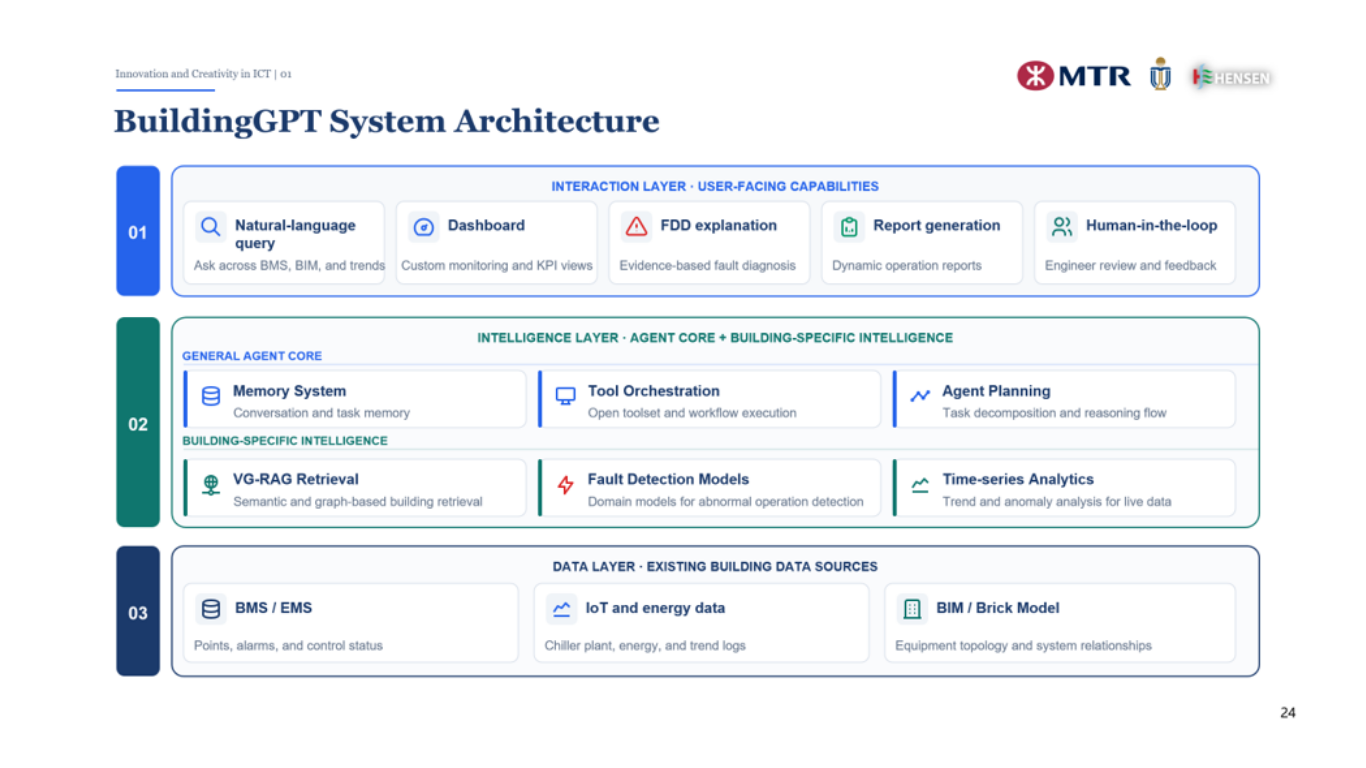
Its research core combines large language models with Brick-based semantic models and Vector-Graph Retrieval-Augmented Generation (VG-RAG), while the operational implementation connects approved BMS data, equipment metadata and O&M knowledge through a read-only, human-in-the-loop interface.
Team Members
- Prof. Walter Zhe WANG — Faculty Supervisor and Project Lead
- Dr. Mingchen LI — Postdoctoral Fellow
- Mr. Shuhao LI — Researcher
- Ms. Qiqi HUANG — Researcher
- Mr. Siqi LI — Researcher
The Problem BuildingGPT Solves
Modern buildings generate massive volumes of data yet lack cohesive operational insights. Because equipment specs, alarms, blueprints, live sensor feeds, and maintenance logs are scattered inside siloed vendor systems, engineers spend substantial time locating data before they can diagnose a problem. Generic AI models often fail to bridge this gap safely, lacking the verified knowledge of physical building topology and operational context.
- Lower the access barrier: facility teams can ask equipment, point, location, relationship, and operating-data questions, eliminating the need to learn SPARQL or vendor-specific point structures.
- Preserve engineering context: semantic relationships and approved O&M knowledge connect raw readings to the equipment and systems they describe.
- Support faster, reviewable action: queries, dashboards, and FDD (Fault Detection and Diagnostics) findings expose the data and reasoning that authorized engineers can verify before acting.
How BuildingGPT Works
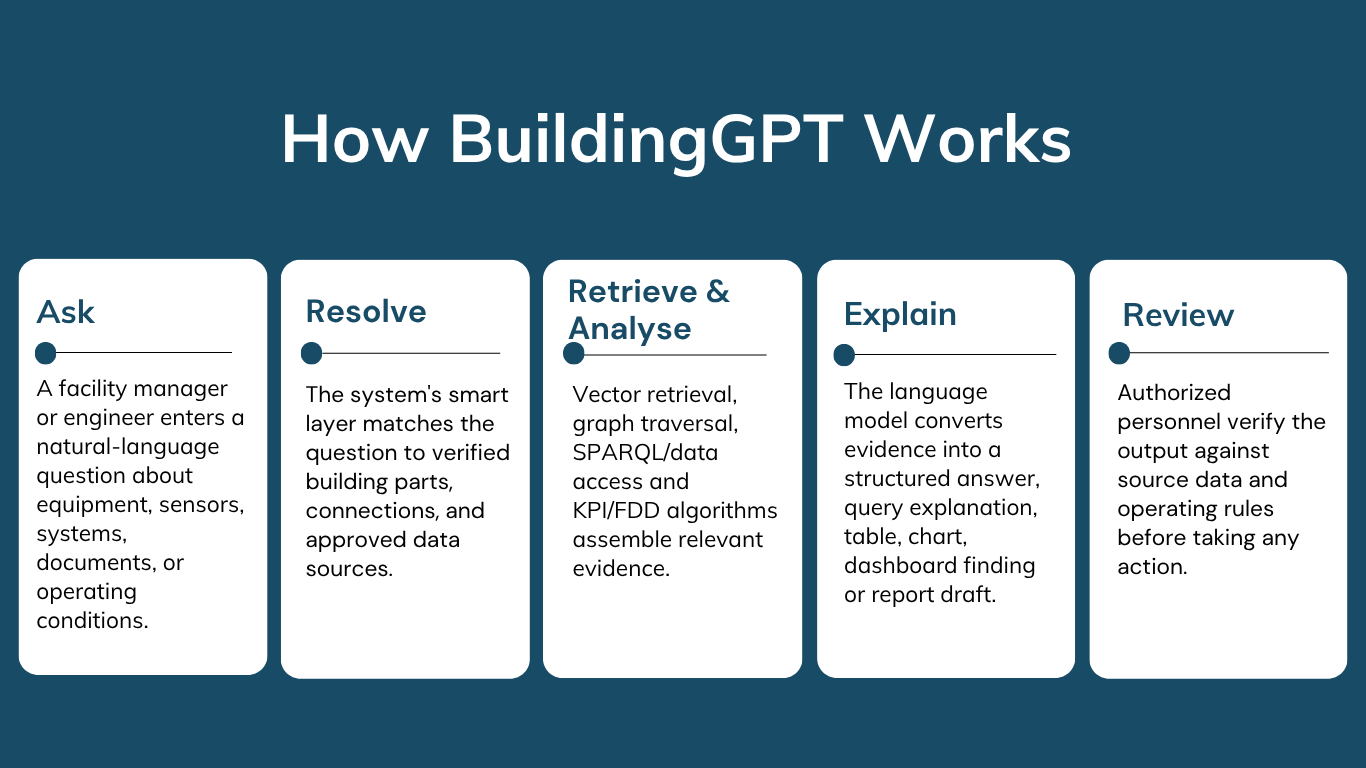
BuildingGPT separates verified building facts from language-model interpretation. The semantic model identifies the correct equipment, topology and data-point roles; approved data services provide current or historical observations; query and analytics modules perform the required computation; and the interface presents a concise answer together with supporting evidence.
Product Demonstration
Watch the video below to see how BuildingGPT bridges complex building data with natural language, letting users query semantic models instantly without writing code.
Practical Value for Building Operators
Designed specifically for facility managers and technical staff to streamline complex workflows securely without direct risk to critical control networks.
- Faster investigation: reduce the time spent locating points, checking equipment relationships, and assembling operational evidence.
Knowledge continuity: make senior engineers' diagnostic logic easier to preserve and reuse, while helping junior staff navigate complex systems. - Explainable review: connect findings to equipment identity, data source, units, time range, and algorithmic evidence instead of relying on unsupported chatbot output.
- Low-disruption adoption: add intelligence above existing infrastructure and expand capabilities in stages, from query and visualization to FDD and report workflows.
- Scalable decision support: reuse semantic and analytical patterns across HVAC equipment, buildings, and portfolios when data and governance permit.
Real-World Testing at ELEMENTS
The system is actively tested at the central cooling plant of ELEMENTS (圓方), a major shopping mall in Hong Kong, in partnership with MTR Corporation, HKUST, and Hensen System Engineering.
Speeding Up Daily Tasks
| Task | Conventional workflow | BuildingGPT-assisted workflow |
| Complex data retrieval | > 1 day | 30 seconds |
| Custom monitoring setup | > 1 day | Approximately 5 minutes |
| Fault-diagnosis workflow | 2-3 days | Approximately 2 minutes |
| Comprehensive report generation | > 7 days | Approximately 3 minutes |
Source: joint MTRC-HKUST-Hensen award-submission materials. These figures are reported workflow turnaround times, not a peer-reviewed energy-savings percentage. Public use requires partner approval.
Milestones & Status
| Milestone / status | Evidence or current position |
| BuildingGPT research | VG-RAG framework has been peer-reviewed and published in the journal Building and Environment (Volume 287, Article 113855, 2026). |
| BuildingGPT2 research | Fine-tuning, VG-RAG and structured reasoning have been peer-reviewed and published in Automation in Construction, Volume 182, Article 106738 (2026). |
| ELEMENTS proof of concept | A local, on-site test deployment at the ELEMENTS mall has completed User Acceptance Testing with MTR frontline staff, operating strictly as a read-only and human-in-the-loop |
| Current implementation | Currently supports natural-language queries, semantic data access, charts/dashboards, automated fault diagnosis (FDD), and report drafting; integration and product hardening continue. |
| IP activity | Joint materials list US provisional application IP.PA.12373.US.PRV, HK filing / approved for filing, and China application CN122153026A. |
| Next stage | Expanding broader air-side networks, reproducible KPI/FDD pipelines, evidence lineage, and expansion to additional properties, subject to partner and governance approval. |
Publications
- Li, M., & Wang, Z. (2026). BuildingGPT: Query building semantic data using large language models and vector-graph retrieval-augmented generation. Building and Environment, 287(Part B), 113855.
- Li, M., & Wang, Z. (2026). BuildingGPT: Query building semantic data using large language models and vector-graph retrieval-augmented generation. Building and Environment, 287(Part B), Article 113855. https://doi.org/10.1016/j.buildenv.2025.113855
- Li, M., Hu, Z., Mohebi, P., Li, S., & Wang, Z. (2026). Enhancing LLM-based building data query with chain-of-thought, retrieval-augmented generation, and fine-tuning. Automation in Construction, 182, 106738.
- Li, M., Hu, Z., Mohebi, P., Li, S., & Wang, Z. (2026). Enhancing LLM-based building data query with chain-of-thought, retrieval-augmented generation, and fine-tuning. Automation in Construction, 182, Article 106738.
- BuildingGPT research demonstration: BuildingGPT: Talk with your building data
- BuildingAgent: Chat with building data