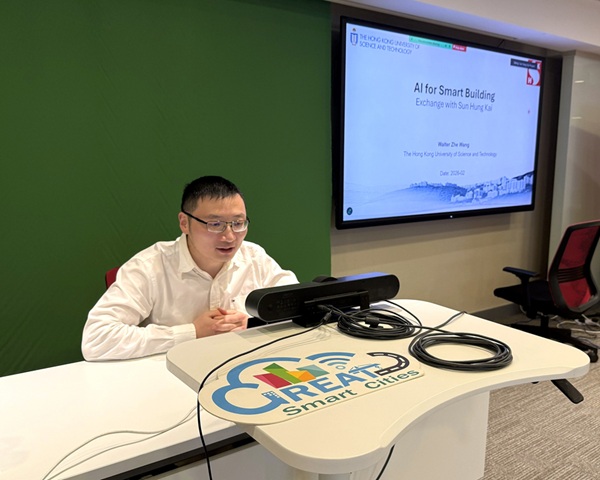
Executive Seminar on AI for Smart Building
Overview
The GREAT Smart Cities Institute (GSCI) at HKUST conducted a high-impact hybrid executive seminar for Sun Hung Kai Properties Limited (SHK) on 4 February 2026. Held at the Sun Hung Kai Centre, this hybrid session brought together SHK leadership and staff from across various subsidiary business units. It also provided an in-depth exploration of how Artificial Intelligence can be leveraged to harmonize building energy efficiency with occupant comfort.
|
Program: |
Executive Seminar: AI for Smart Buildings |
| Date & Time: |
4 February 2026 (Wed) | 4:30 – 6:00 PM |
| Format: | Training Room, 4/F, Sun Hung Kai Centre (Hybrid) |
| Target Audience: | All levels of SHK staff and subsidiary business units |
| Speaker: |
Prof. Walter Wang, Department of Civil and Environmental Engineering, HKUST |
Objectives: Upskilling for a Sustainable Future
The primary mission of this session was to educate and empower the SHK workforce to lead the transition toward AI-integrated property management. The training focused on:
- AI Literacy in Green Buildings: Breaking down complex algorithms into actionable insights for the built environment.
- Operationalizing ESG Targets: Showing how AI-based engineering directly supports corporate ESG mandates and energy reduction targets.
- Capacity Building: Training staff to recognize operational "pain points"—such as HVAC inefficiency or occupant discomfort—as candidates for smart technology solutions.
Program Highlights
Prof. Wang presented two key research-backed solutions designed to redefine building performance:
- Precision Chiller Sequencing: Moving beyond manual "rules of thumb," Prof. Wang demonstrated how AI optimizes cooling plant ON/OFF control. Evidence from field tests at Ruihong Tiandi Sun Palace showed an 11.14% annual energy saving rate, equivalent to saving 495,000 kWh per year through logic optimization alone.
- Bayesian Inference for Climate Control: The seminar explored the use of advanced probabilistic modeling to solve the "thermostat wars" in shared offices. By utilizing Bayesian Inference, the system automatically learns and predicts the optimal temperature setpoint that maximizes comfort for the highest number of occupants simultaneously.
Partner With Us
For inquiries regarding our executive courses or to discuss a customized pilot solution for your organization, please Contact Us for Bespoke Training and Pilot Programs.
Related News & Research
- GSCI Green Building Cluster
- Optimal Chiller Sequencing by Walter Zhe Wang
- Executive Committee: Zhe Wang
Frequently Asked Questions
Q: Is this AI solution applicable to existing buildings?
A: Yes. The training emphasized "lightweight" AI solutions that can be integrated into existing Building Management Systems (BMS) without requiring massive hardware overhauls.
Q: How does Bayesian Inference differ from a standard thermostat?
A: Traditional thermostats follow a fixed rule. Bayesian Inference "learns" from occupant data over time, finding a mathematical "sweet spot" that satisfies diverse preferences in a shared space.
Q: Can this program be customized for other business units?
A: Absolutely. GSCI specializes in bespoke training tailored to the unique challenges of different property types, from retail malls to residential complexes.